
Boat Winterization Checklist Before Storage: 15 Steps
By FindBoatStorage Research Team · Published February 2026 · Updated March 2026 · Based on verified data from our directory
Why Proper Winterization Is Non-Negotiable
Skipping even a single winterization step can result in a cracked engine block, corroded fuel system, mold-covered interior, or a hull that requires thousands of dollars in repair before it sees water again. Based on our work with boat owners across our database of 10,431 verified storage facilities in 48 states, the most common source of preventable spring repair costs is incomplete winterization, not weather damage, not theft, but owner negligence during fall prep.
This guide covers everything for powerboats (inboard, outboard, and stern drive) with notes for sailboats and PWC where the process differs significantly. Follow this checklist before dropping your boat at any storage facility. For help choosing the right facility type for winter storage, see our indoor vs outdoor comparison.
Month-by-Month Fall Preparation Timeline
Successful winterization is not a one-day event. It is a process that begins weeks before you plan to put the boat in storage.
- August/September: Schedule a haul-out or service appointment. Demand at marine service yards spikes in October. Book early. Order consumables (fuel stabilizer, fogging oil, antifreeze, new zincs).
- October (before last use): On your last outing, run the boat hard for 20+ minutes to heat the engine and burn off any water in the oil. Top off the fuel tank to minimize condensation space.
- October/November (winterization day): Execute the full checklist below. Do not split it across multiple days if possible. Steps are interdependent and it is easy to forget where you left off.
- November to March (in storage): Check on the boat once a month if possible. Look for cover damage, standing water, and signs of pest activity. Check battery voltage if connected to a trickle charger.
- April (pre-launch preview): See the spring de-winterization section at the end of this guide.
Engine Winterization: Inboard vs. Outboard vs. Stern Drive
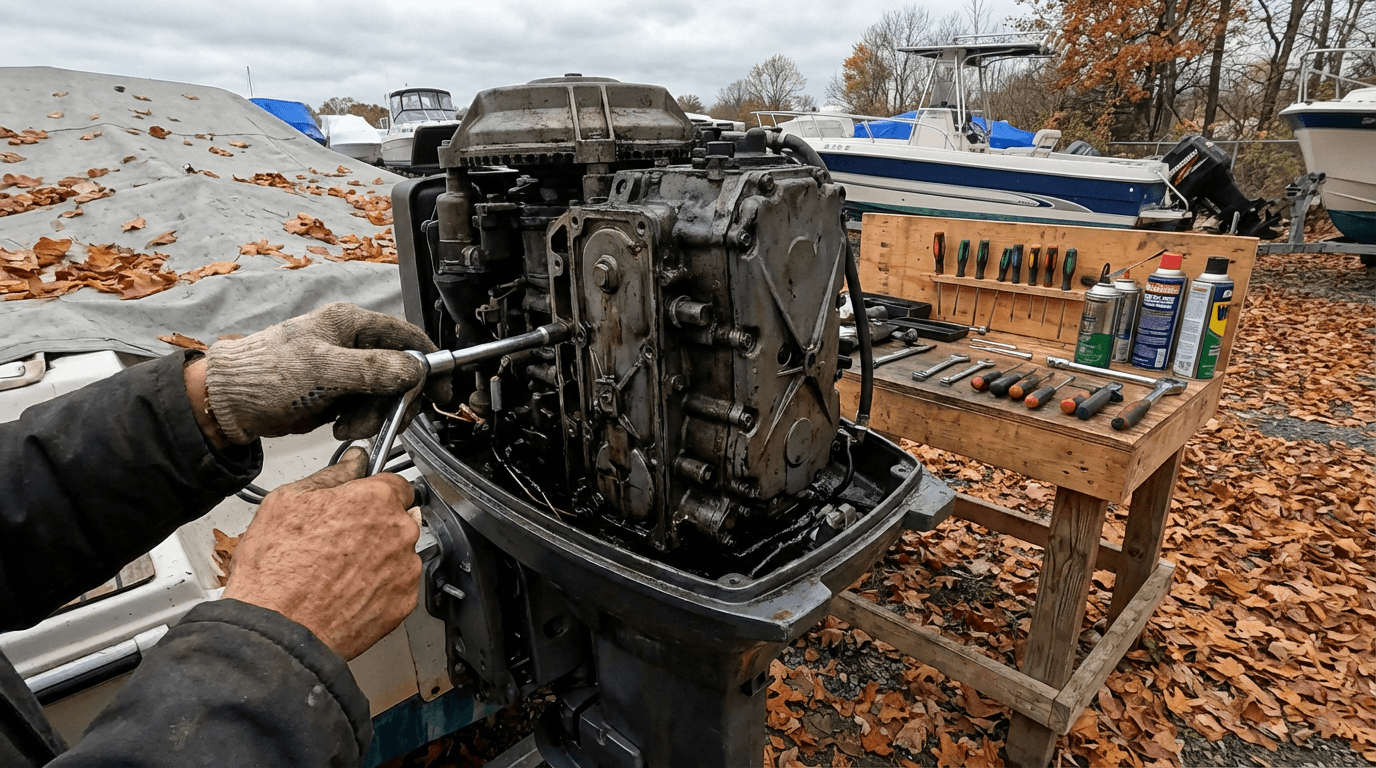
Outboard Engine Winterization
Outboards are the most common engine type in our facility database and the most straightforward to winterize:
- Flush the cooling system: Run fresh water through the engine using a garden hose and flushing muffs for 5 to 10 minutes. This removes salt, silt, and contaminants from the water passages. For saltwater boats, this step is critical: salt crystallizes in passages and causes corrosion.
- Add fuel stabilizer: Add stabilizer to the tank per the product label (typically 1 oz per 2.5 gallons). Run the engine for 10 minutes to circulate it through the carburetors or fuel injectors. Ethanol-blended E10 fuel begins to degrade in 30 days without stabilizer, forming phase separation and varnish deposits.
- Fog the engine: While the engine is running, spray fogging oil into each carburetor intake (or through the air intake for EFI engines). The engine will smoke: this is normal. Shut it off while still spraying. The oil coats cylinder walls, valves, and piston rings to prevent rust.
- Change engine oil (4-stroke outboards): Drain and replace with fresh oil. Acidic combustion byproducts in used oil corrode cylinder walls over winter.
- Change gear lube: Drain the lower unit, inspect for water (milky appearance indicates a seal leak), and refill with fresh gear lube. Water in gear lube expands when frozen and can crack the gear case, a $500 to $2,000 repair.
- Grease fittings and pivot points: Apply marine grease to steering cables, throttle and shift cables, tilt/trim pivot points, and propeller shaft.
- Remove and store the propeller: Grease the prop shaft, slide the prop off, inspect for dings and fishing line, and store separately indoors.
Inboard Engine Winterization
Inboards require more careful attention to the raw water cooling system:
- Change oil and filter: same reasons as outboard
- Fog cylinders: remove spark plugs, spray fogging oil into each cylinder, reinstall plugs
- Flush and winterize the raw water cooling system: Close the raw water seacock, disconnect the raw water intake hose, place the end in a bucket of RV antifreeze (propylene glycol, non-toxic), and crank the engine until pink antifreeze exits all discharge points. This is the critical step most DIYers get wrong. All water must be replaced with antifreeze in manifolds, heat exchangers, and exhaust elbows.
- Drain the freshwater cooling circuit (if closed cooling system equipped)
- Change transmission fluid (consult manufacturer schedule)
- Inspect and service the impeller: replace if more than 2 seasons old; an impeller failure causes engine overheating and can destroy the engine
Stern Drive (I/O) Winterization
Stern drives combine elements of both inboard and outboard winterization:
- Winterize the inboard engine as above
- Remove the outdrive and inspect the bellows (gimbal bellows, exhaust bellows, shift bellows). Cracked bellows allow water into the boat and are a common failure point
- Grease the u-joints and pivot points
- Change gear lube in the outdrive lower unit
- Tilt the drive to the fully up position or remove it for winter storage
Fuel Stabilizer Dosing by Tank Size
| Tank Size | Stabilizer (1 oz per 2.5 gal) | Stabilizer (1 oz per 10 gal heavy-duty) |
|---|---|---|
| 10 gallons | 4 oz | 1 oz |
| 25 gallons | 10 oz | 2.5 oz |
| 50 gallons | 20 oz | 5 oz |
| 100 gallons | 40 oz | 10 oz |
| 150 gallons | 60 oz | 15 oz |
Use the standard dose for E10 fuel stored 3 to 6 months; use heavy-duty/double dose for E15 fuel or storage beyond 6 months. Fill the tank to 95% before adding stabilizer, a full tank minimizes condensation and oxidation space.
Battery Storage Best Practices
Marine batteries are expensive ($100 to $400 each) and surprisingly easy to destroy through improper storage:
Option 1: Remove and Store Indoors
- Fully charge before removal
- Store on a wood or plastic shelf (not concrete, this does not drain batteries, but moisture from concrete can cause corrosion on terminals)
- Connect to a smart trickle charger (also called a battery maintainer). This keeps the battery at 100% charge without overcharging
- Check voltage monthly: below 12.2V indicates sulfation beginning; charge immediately
Option 2: Leave Installed with Trickle Charger
- Only practical if your storage facility has shore power hookups
- Use a smart charger (not a basic trickle charger). Dumb chargers can overcharge and boil the electrolyte
- Disconnect the negative terminal to eliminate parasitic draws from electronics
Batteries left fully discharged over winter will sulfate permanently and lose 20 to 50% of their capacity. A $40 smart charger is cheap insurance against a $300 battery replacement.
Freshwater System Flushing (Boats with Onboard Water)
For boats equipped with fresh water systems (sinks, showers, heads):
- Drain all freshwater tanks completely
- Open all faucets and the shower drain valve
- Blow out all lines with compressed air (preferred) or add RV antifreeze
- Flush the toilet and add RV antifreeze to the bowl and the fresh and waste water lines
- Open all seacocks and flush with fresh water, then leave open (tape them open with bright tape so you remember to close them in spring before launching)
- Empty the holding tank: never store a boat with waste in the holding tank
Canvas, Cover, and Shrink Wrap Selection
The right cover protects your investment; the wrong cover creates new problems:
- Manufacturer covers: Fitted, breathable, often the best solution for boats stored covered or indoors. Allows moisture to escape, preventing mold.
- Shrink wrap: Ideal for outdoor storage in harsh winters. Creates a tight, moisture-excluding barrier. Must include ventilation patches to prevent condensation buildup inside. Cannot be reused. Budget $200 to $600 for professional application.
- Universal covers: Inexpensive but often fit poorly. Pooling water and wind chafing are common problems. If using a universal cover, install support poles or a frame to prevent water pooling.
Never use a completely waterproof cover without ventilation on a stored boat. You will have a mold problem by spring. See our boat cover selection guide for detailed comparisons.
Hull Inspection Before Storage
Winter is the best time to address hull issues. It gives you all winter to plan and budget repairs:
- Inspect the entire hull for gelcoat cracks, stress cracks, or blistering (osmotic blistering is common on fiberglass boats)
- Check the transom for soft spots (press firmly across the entire transom surface, soft or spongy areas indicate water intrusion)
- Inspect all through-hull fittings and seacocks. Operate each seacock to ensure it is not seized
- Check and replace zincs (anodes): replace any that are more than 50% depleted
- Photograph all damage for insurance documentation before the boat goes into storage
Preventing Rodent Damage
Mice and rats can cause thousands of dollars in damage during winter storage. Chewed wiring harnesses, nesting in insulation, and contamination of interior surfaces are all common:
- Stuff steel wool in any gaps around cables, wiring, exhaust tubes, and fresh air vents
- Place Victor Tin Cat or similar enclosed traps throughout the interior
- Scatter peppermint oil-soaked cotton balls (rodents dislike the scent) throughout the cabin
- Use commercial rodent repellent pouches in storage areas
- Tape over any openings in the engine cover or cowling
- Remove all food, including sealed packages: rodents will chew through plastic and foil
What to Remove from the Boat Entirely
- All electronics not permanently wired: chartplotters, fish finders, stereo head units, VHF radios
- Life jackets, throw cushions, and safety equipment (store indoors to extend life)
- All food, beverages, and perishables (even sealed cans, frozen cans burst)
- Fishing gear, tackle boxes, rods
- Removable upholstery cushions (store flat indoors to prevent compression damage)
- Portable fire extinguishers (have them serviced annually if due)
- Anchor and rope if possible (heavy and takes up storage space unnecessarily)
Indoor vs. Outdoor Winter Storage: Which Is Right for Your Boat?
| Factor | Outdoor Uncovered | Outdoor Covered | Indoor Enclosed |
|---|---|---|---|
| Weather protection | None | Partial (rain/snow) | Full |
| UV protection | None | Good | Full |
| Temperature swings | Full exposure | Full exposure | Moderated |
| Pest risk | High | Moderate | Lower |
| Shrink wrap needed | Strongly recommended | Recommended | Not needed |
| Monthly cost | Lowest | Moderate | Highest |
| Best for | Budget-conscious, newer boats | Good value compromise | Older boats, high-value vessels |
When to Hire a Professional vs. DIY
DIY winterization is absolutely viable for most boat owners, but there are specific situations where professional service is worth the cost ($200 to $500 at most marine service centers):
- Inboard or stern drive engines if you have not done it before. Mistakes are expensive
- Boats with complex freshwater systems (galley, shower, head)
- Boats with raw water cooling systems that require antifreeze flushing
- High-value vessels where the cost of a mistake far exceeds service cost
- When you lack the tools (fogging spray, impeller puller, gear lube pump)
Outboard engines on open boats are generally straightforward for mechanically competent owners with a service manual. When in doubt, pay a professional once and watch carefully. You will have the knowledge to DIY confidently the following year.
Spring De-Winterization Preview
A properly winterized boat requires less work in spring than you might expect. Your spring checklist will include:
- Reinstall batteries and check charge
- Close all seacocks before launching
- Replace fogged spark plugs if oil fouling is present
- Replace impeller if you removed it for inspection
- Check engine oil and all fluid levels
- Inspect all belts and hoses
- Run engine on a flush muffs connection before launching to check for leaks
- Perform a brief sea trial in calm water before extended use
See our detailed spring recommissioning checklist for the full launch sequence. To find quality winter storage near you, use our verified facility directory and filter for indoor or covered storage options.
Find Boat & RV Storage Near You
Free cheat sheet
Know a fair storage price before you call
Get the 2026 Boat & RV Storage Cost Cheat Sheet: median monthly prices by storage type, the most and least expensive states, and the questions to ask before you book. Built from 10,000+ real facilities.
No spam. Unsubscribe anytime.