
How to Choose the Right Boat Storage: Complete Guide
By FindBoatStorage Research Team · Published January 2026 · Updated February 2026 · Based on verified data from our directory
Picking the wrong boat storage facility costs money in two ways: you pay for features you do not need, or you underpay and come back in spring to find weather damage, theft, or deterioration that could have been prevented. This guide covers every major type of boat storage available in the US, the selection criteria that actually matter, specialty considerations for different boat types, seasonal versus year-round storage decisions, and the specific questions you should ask before signing any rental agreement.
The 6 Types of Boat Storage
1. Outdoor Open Lot Storage
Your boat and trailer sit on a paved or gravel lot with no overhead cover. This is the lowest-cost option and the most widely available. The trade-off is full exposure to sun, rain, hail, bird droppings, and wind-driven debris. UV radiation damages canvas covers, upholstery, and gelcoat surface finishes over time, and rain infiltration through deteriorating covers or canvas adds up to mold and mildew inside the cabin.
Typical monthly cost: $50–$150 depending on location and lot quality.
Best for: Boat owners on a tight budget who maintain quality covers and inspect the boat regularly, owners in mild climates where UV is the main concern, and those who use their boats frequently enough to monitor condition between trips.
2. Covered Carport Storage
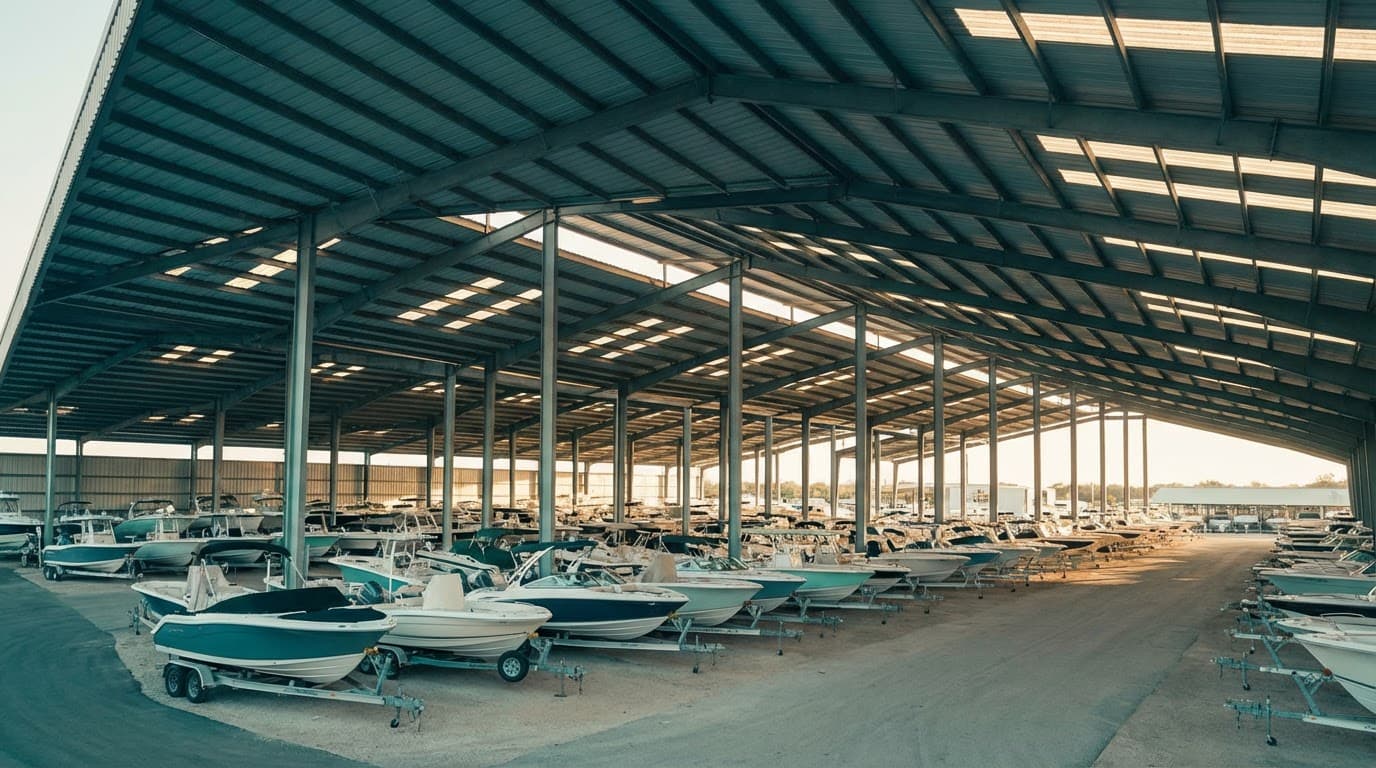
A metal or fabric roof over your parking space provides protection from direct sun and most precipitation, while the open sides allow air circulation. This middle-tier option is popular because it provides meaningful protection at a price typically 30–60% lower than enclosed storage. Covered storage dramatically extends the life of canvas components, upholstery, gelcoat, and deck hardware compared to fully exposed outdoor storage.
Typical monthly cost: $75–$200 depending on space size and location.
Best for: Most trailered boats — ski boats, fishing boats, pontoon boats — that need protection from rain and UV without the cost of an enclosed unit. Works well year-round in climates where temperature extremes are not severe.
3. Enclosed Indoor Storage
Your boat is stored inside a building, completely protected from all weather. Enclosed storage provides the highest level of protection and security. Some facilities are climate-controlled, which is particularly valuable in extreme-heat climates (Phoenix, Las Vegas) where sustained temperatures above 110°F degrade adhesives, rubber components, and fiberglass. Climate-controlled enclosed storage is also ideal for boats with significant electronic systems that are sensitive to temperature swings.
Typical monthly cost: $150–$500+ depending on boat size, unit type, and location.
Best for: Boats valued at $30,000 or more, performance boats with sophisticated electronics, any boat stored for 6+ consecutive months, and boats in climates with significant hail risk or extreme temperature swings. Many insurers offer premium reductions for verified indoor storage.
4. Marina Wet Slip
Your boat stays in the water at a dock, assigned to your slip by the linear foot of boat length. A wet slip is the most convenient option for frequent boaters — you walk down, start the engine, and go. There is no towing, no launch ramp, and no trailer maintenance to deal with. The downsides are significant: slips are the most expensive storage option, the hull is subject to constant biofouling (barnacles, algae, and slime) that requires regular cleaning and antifouling bottom paint, and the risk of damage from wakes, weather, dock contact, and wave action is elevated compared to dry storage.
Typical monthly cost: $10–$30 per foot of boat length — a 25-foot powerboat in a mid-market marina runs $250–$750/month. High-demand coastal marinas can exceed $50 per foot.
Best for: Power boaters and sailors who use their boats weekly or more, owners in markets where launch ramps are congested or unavailable, and anyone who values the convenience of ready-to-go water access over cost savings.
5. Dry Stack Storage
A marina stores your boat on metal racks inside a large warehouse building using a forklift. You call ahead (typically 1–2 hours notice), and the marina has your boat in the water ready when you arrive. You return after your trip, and the marina pulls the boat out, flushes the engine, and stacks it back. This option combines full indoor protection with rapid water access — a significant advantage over trailered storage for frequent boaters who want protected storage.
Typical monthly cost: $150–$450+ depending on boat size and facility location.
Limitations: Dry stack is restricted to boats that fit the rack system — generally powerboats under 35 feet and under a specified weight limit. Sailboats with masts cannot be racked. Availability is limited to facilities near the water that have invested in the forklift infrastructure.
Best for: Powerboat owners near coastal or lake marinas who want the convenience of marina access and the protection of indoor storage, particularly those who go out frequently enough to justify the advance-notice requirement.
6. Self-Storage Facility with Boat Parking
Standard self-storage companies often designate part of their property for boat and RV storage. These spaces range from basic outdoor spots on a gravel lot to covered units comparable to dedicated marine storage facilities. Pricing is frequently lower than at dedicated facilities, and they are more common in suburban and inland markets away from the water. Security quality varies widely.
Typical monthly cost: $50–$200 depending on space type.
Best for: Inland boat owners in markets without specialized marine storage facilities, and owners looking for budget options who are willing to evaluate each facility carefully on its own security and condition merits.
Key Factors to Evaluate When Choosing a Facility
Location and Proximity to Water
Every mile between your storage facility and the boat ramp adds trailer towing time and fuel cost on every trip. If you boat 20 times per year and the cheaper facility is 10 miles farther from the ramp than the alternative, you are adding approximately 400 miles of towing per season. Over 5 years, that adds up to real cost and wear on your tow vehicle. Factor in your realistic annual use frequency before choosing a less convenient but cheaper option.
Security Features
Security is the most important factor after price. The minimum acceptable setup for any boat storage facility is: perimeter fencing (chain link or better), a gated entry controlled by keypad or key card, and security cameras covering the full storage area. Better facilities add motion-activated lighting, regular security patrols, and individual space alarms.
Ask the facility manager directly whether there have been any break-ins, thefts, or vandalism incidents in the past 12 months. A reputable facility will answer honestly. You can also browse verified facilities in our directory and read reviews from other boat owners about their security experiences. If your boat has a value above $15,000, do not store it somewhere without verified, functional security infrastructure.
Access Hours
Access policies vary significantly. Some facilities offer 24/7 access with no restrictions. Others require you to retrieve your boat during staffed business hours — typically 8am–5pm on weekdays. If you fish early-morning departures, take spontaneous weekend trips, or like to return after dark from an evening on the water, office-hours-only access is a serious operational constraint. Confirm the exact gate hours and access procedure before signing.
Space Dimensions
Measure your boat, trailer, tongue, and outboard motor before visiting any facility. Bring the measurements with you. The listed stall size at many facilities is the total stall length — not the usable length after accounting for gate swing clearance, drainage grates, concrete curb placement, or proximity to the neighboring unit. A stall listed at 30 feet may only accommodate a 27-foot rig once you account for all clearances. Confirm dimensions with staff and use a tape measure on-site before paying a deposit.
Surface and Drainage
Paved, well-drained lots are preferable to gravel or compacted dirt for boats stored on trailers. Standing water after heavy rain promotes corrosion on trailer frames, rots wooden bunks, and allows moisture to wick up into the hull if the boat sits at an unfavorable angle. Ask about drainage and inquire whether the lot has a history of standing water issues during heavy rains.
Insurance Requirements
Most reputable facilities require proof of liability insurance before allowing move-in. Some specify a minimum coverage amount — commonly $100,000 liability coverage. If you do not already carry a marine insurance policy, factor that cost into your overall storage budget. Keep in mind that the facility's insurance covers the property, not your boat — your own policy must cover loss or damage to the vessel itself.
Contract Terms
Read the full rental agreement before signing. Key items to verify: the lease term and whether month-to-month is available, the required move-out notice period (often 30 days), the facility's liability limitations, what happens to your boat if you miss a payment, and whether there are any restrictions on maintenance activities (working on the engine, applying antifouling paint, charging batteries) on the premises.
Questions to Ask Before You Sign
- What is the exact usable stall length, width, and height clearance?
- What are the access hours — is there truly 24/7 access, or are there gate-closing times?
- What security systems are in place — cameras, fencing, lighting, alarms, patrols?
- Have there been any thefts, break-ins, or vandalism incidents in the past 12 months?
- What proof of insurance is required? What minimum coverage amount?
- Is the lease month-to-month or annual? Is there a prepay discount?
- What is the required move-out notice?
- Are there electrical hookups available? What amp service?
- Is there a dump station, wash bay, or boat launch on the property?
- What are the rules on performing maintenance, running engines, or charging batteries on-site?
- What happens if I need to terminate the lease early?
- Is the lot paved? What is the drainage situation?
Seasonal vs. Year-Round Storage
Owners in northern states typically store their boats October through April — roughly 6–7 months of the year. In southern states and warm-weather markets, many owners use year-round storage and simply pay for the convenience of having the boat readily accessible at all times rather than storing at home.
If you store seasonally, look for facilities that offer short-term or seasonal contracts rather than locking you into a 12-month agreement. Many dedicated marine storage facilities offer 6-month seasonal rates that are more economical than paying month-to-month for the same period. Ask whether the facility provides winterization services — some will drain your engine, fog the cylinders, and stabilize the fuel as add-on services, which is valuable if you want professional help with the process.
Specialty Storage Considerations by Boat Type
Sailboats
Sailboats with standing rigging (the mast and its supporting cables) require special consideration. Most outdoor and covered storage facilities accommodate sailboats with the mast down — stored horizontally in cradle supports or on a trailer. Dry stack storage is generally not available for sailboats due to mast height. Wet slips are the primary storage solution for sailboats whose owners want to keep the mast up and rigged.
When storing a sailboat with the mast down, confirm the facility has adequate support equipment or that you will be bringing your own cradle or stands. Improper support on a fiberglass hull can cause stress damage over a long storage period.
Pontoon Boats
Pontoon boats are wide (typically 8–10 feet) and require adequate stall width to avoid damage to the deck rails and furniture. Confirm that covered stall width accommodates your specific beam. Pontoon decks are also particularly susceptible to UV damage on seat cushions, vinyl, and carpet — covered or enclosed storage provides meaningful protection compared to outdoor lots.
Personal Watercraft (Jet Skis)
PWC are compact enough to use standard self-storage units or small outdoor stalls. Many owners store PWC in shared trailer stalls or on multi-unit stands. Because they are small and portable, they are also more easily stolen — look for facilities with good camera coverage and secure individual space access rather than open shared lots.
Large Powerboats and Sportfishers
Boats over 30 feet often have limited dry-land storage options due to size and weight. Wet slips, dry stack (where available), and large enclosed or covered stalls at dedicated marine facilities are the primary options. Confirm that the facility's crane or forklift — if it handles launches — is rated for your boat's weight. For boats stored on trailers, verify that the facility's paved surface is rated for the combined weight of boat and trailer.
Red Flags to Avoid
- No perimeter fencing or cameras — an open lot with no security infrastructure is a high-theft environment for boats
- Staff who cannot or will not answer questions about recent incidents
- Stalls that are significantly smaller than advertised once you measure in person
- Facility that requires annual prepayment but has poor online reviews about refund disputes
- Evidence of standing water — water stains on neighboring trailers, rutted gravel, or poor drainage infrastructure
- No insurance requirement — facilities that do not require proof of insurance often have lax overall management standards
Boat Storage Checklist
- Measure your complete rig: boat, trailer, tongue, and motor at its highest point
- Confirm space dimensions with staff in person, not just from the website
- Check Google reviews and look specifically for any theft, damage, or flooding complaints. Browse verified facilities in our directory
- Verify security infrastructure: fence, gate, cameras, lighting
- Confirm exact access hours — get the gate schedule in writing
- Read the full lease agreement before signing
- Confirm insurance requirements and update your marine policy if needed
- Ask about any prepay discounts or seasonal rates
- Visit in person to assess lot condition, drainage, and neighborhood
- Ask about recent theft or vandalism incidents
Taking an hour to evaluate a storage facility properly before signing can protect a major financial asset. The lowest-priced option is rarely the best value once you factor in security exposure, access inconvenience, and the long-term cost of inadequate weather protection.
Related Tools
📐Storage Size Guide →
Find the right spot size for your specific vehicle — with storage type recommendations.