
How to Find Boat Storage Near You: A Complete Guide
By FindBoatStorage Research Team · Published February 2026 · Updated March 2026 · Based on verified data from our directory
If you're searching for boat storage near you, you're not alone. With millions of recreational boats registered across the United States, the demand for safe, affordable storage has never been higher. Whether you own an 18-foot fishing boat, a pontoon, or a large cabin cruiser, finding the right storage facility close to home saves time, money, and stress.
This guide walks you through everything you need to know to find the best boat storage near you — including types of storage, what to look for, how to compare prices, regional availability, and the strategies that experienced boaters use to find and negotiate better rates. Based on our database of 10,431 verified facilities across 48 states, we have compiled the most comprehensive guide available for 2026.
Types of Boat Storage Near You
Outdoor Uncovered Storage
The most affordable option. Your boat is parked on a gravel or paved lot, typically behind a secured fence. Monthly rates range from $30–$150 depending on location and boat size. Best for boats used frequently that don't need year-round weather protection. Exposure to UV, rain, and temperature cycles means a quality breathable boat cover is essential.
Covered / Carport Storage
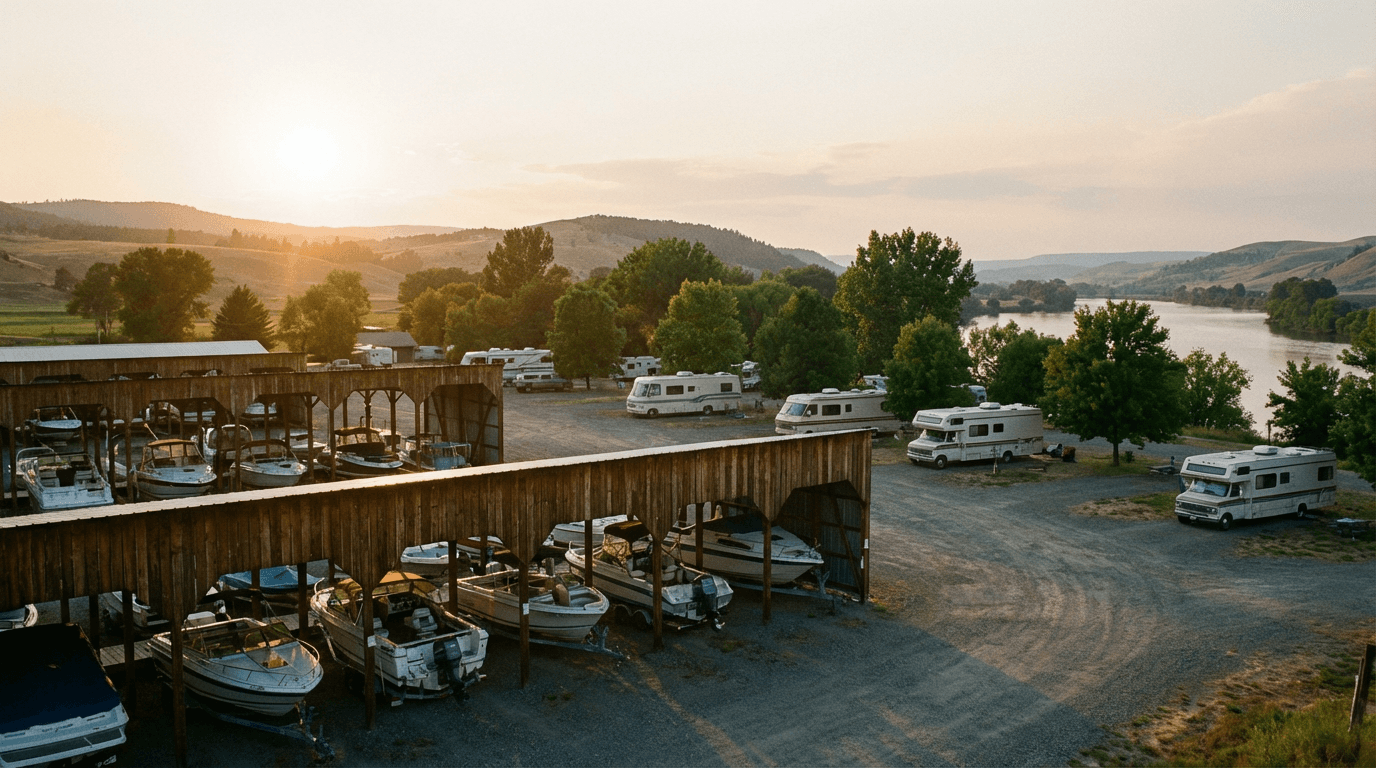
A roof over your boat but open on the sides. Protects from sun, rain, and snow without the premium price of a fully enclosed unit. Common rate: $75–$250/month. The roof overhead extends cover life significantly and eliminates the snow load concern in northern states.
Indoor / Enclosed Storage
Your boat goes inside a warehouse-style building. Maximum protection from the elements, theft, and UV damage. Rates typically run $150–$500/month depending on boat size. Ideal for off-season storage or high-value vessels. Compare indoor vs. outdoor storage in detail to determine which is right for your situation.
Climate-Controlled Storage
A subset of indoor storage with temperature and humidity regulation. Best for fiberglass hulls or if you live in an area with extreme winters. Temperature control prevents the freeze-thaw cycling that stresses hull fittings and through-hulls. Expect to pay a 20–40% premium over standard indoor rates. Worth every dollar for high-value sailboats, trawlers, and specialty fiberglass boats.
Dry Stack Storage (Marinas)
Your boat is stored in a multi-level rack system at a marina and fork-lifted in and out of the water on demand. Extremely convenient for regular boaters — call ahead, arrive, and your boat is already in the water. Typically limited to boats under 30 feet and under a certain weight. Monthly rates for dry stack are often comparable to indoor storage, with the significant benefit of immediate water access.
States with the most dry-stack marinas: Florida has the most dry-stack facilities nationally, followed by South Carolina, Georgia, and North Carolina along the Southeast coast. California has significant dry-stack availability in the Bay Area, San Diego, and Los Angeles. Texas (particularly Galveston and the Gulf Coast) and Louisiana also have well-developed dry-stack infrastructure.
Wet Slip Storage
A permanent dock slip where your boat stays in the water year-round. Most convenient for frequent boaters but also the most expensive — and not available in all regions. Monthly wet slip rates range from $200/month in rural freshwater locations to $2,000+/month in premium coastal marinas. Barnacle growth, osmotic blistering, and through-hull wear are accelerated by year-round wet storage, requiring more active maintenance.
Storage Type Availability by Region
The type of storage available to you depends significantly on where you are located:
| Region | Most Available Type | Notes |
|---|---|---|
| Southeast (FL, SC, GA, NC) | Dry stack, wet slip, outdoor | Highest dry-stack marina density in the US; year-round boating season reduces long-term storage demand |
| Great Lakes (MI, OH, MN, WI) | Outdoor, covered, indoor | Strong winter storage demand drives excellent indoor options; shrink wrap widely available |
| Northeast (NY, NJ, MA, CT) | Indoor, covered, wet slip | High density of marinas; indoor storage premiums are highest in the US due to land costs |
| Gulf Coast (TX, LA, AL, MS) | Outdoor, wet slip, dry stack | Year-round mild weather reduces demand for enclosed storage; outdoor rates are among the lowest nationally |
| Pacific Coast (CA, WA, OR) | Indoor, wet slip, dry stack | Premium coastal markets drive up wet slip and indoor prices; mild weather means outdoor storage is viable year-round |
| Inland West (AZ, NV, CO, UT) | Outdoor, covered | Lake Powell, Lake Mead, and reservoir boating; outdoor storage with UV covers essential in high-sun environments |
| Mountain States (CO, MT, ID) | Outdoor, covered, indoor | Short season; strong winter storage demand; altitude means intense UV even without coastal humidity |
How to Find Boat Storage Near You
The fastest way to find boat storage near you is to use our directory:
- Enter your city or ZIP code in the search bar — results are sorted by proximity.
- Filter by storage type (outdoor, covered, enclosed, dry stack) to match your needs and budget.
- Compare prices and ratings side by side — we show verified monthly rates and Google ratings for every facility.
- Check amenities — 24/7 access, security cameras, wash bays, and boat ramp access are key differentiators.
- Contact the facility directly — all phone numbers, addresses, and websites are verified.
Using the FindBoatStorage.com Directory Effectively
Our directory includes filtering options that go beyond most search tools. Here is how to get the most out of the search:
- Filter by boat type: Not all facilities accept all boat types. Use the accepts_boats / accepts_rvs filters to eliminate irrelevant results immediately.
- Filter by max vehicle length: If you own a 38 ft cruiser, filter by minimum length accommodation to avoid calling facilities that cannot physically fit your boat.
- Filter by amenities: Boat ramp access, wash bay, and dump station are specific features not available at all facilities — filter for the ones that matter to you before calling.
- Check distance to water: Our listings include distance to the nearest water body where data is available. For lake boaters especially, storage location relative to the boat launch dramatically affects convenience.
- Read the facility profile fully: Many listings include storage type detail, access hours, security features, and customer rating context that helps narrow your selection before calling.
What to Look for in a Boat Storage Facility
Security
At minimum, look for gated access with a key code and security cameras with recorded footage. On-site managers and individual unit alarms add another layer of protection. Your boat is a significant investment — don't compromise on security. See our full guide on boat storage security features to understand what to look for in detail.
Access Hours
If you boat on weekends and early mornings, make sure the facility offers 24/7 gate access. Many facilities have restricted hours (typically 6am–10pm), which can be frustrating if you want to launch early or return late. Confirm access hours before signing, not after.
Distance from Launch Ramp
The closer your storage facility is to your favorite lake, river, or bay, the better. Every mile between your storage facility and your launch ramp is a mile you are pulling a trailer — adding time and fuel cost to every outing. Use our map view to find facilities nearest to your preferred water body.
Boat Size Compatibility
Not every facility can accommodate every boat. Check the maximum vehicle length listed on each facility's profile before you reserve. For boats over 30 feet, filter specifically for facilities with length accommodation confirmed — many facilities cap at 28 or 30 feet for indoor spaces.
Storage for Oversized Boats (40 ft and Above)
Finding storage for larger vessels — 40 ft cruisers, trawlers, large sailboats, and sports fishers — requires a more targeted search. Options narrow considerably above 40 feet:
- Dedicated marine storage facilities (not self-storage) are the primary option. These purpose-built facilities have equipment for handling large boats and typically offer 14–16 ft indoor clearance.
- Marina yard storage — boats stored on stands in a marina boat yard. Common at coastal marinas and sailing clubs. Typically charged by the foot per month. Includes haul-out and block-up service.
- Wet slip — for very large boats, a permanent wet slip may be the most practical solution. Suitable for boats that are too large for any available indoor or covered storage in the area.
- Shrink wrap in the marina yard — for winter in northern regions, having a large boat blocked in a marina yard and shrink-wrapped by the marina is the standard approach above approximately 35 ft.
Use our directory's length filter to find facilities that can accommodate your specific vessel size. For boats 40 ft and above, calling ahead is essential — not all large-boat accommodations are reflected in online listings.
Evaluating Storage Facility Reviews Effectively
Online ratings provide useful data but require interpretation. Here is how to read storage facility reviews like an expert:
- Look at the review count, not just the star rating: A facility with 4.8 stars from 6 reviews is less reliable than one with 4.3 stars from 200 reviews.
- Read 1-star reviews first: Complaints about security incidents, flooding, rate increases without notice, and access problems are the most important signals.
- Look for the owner's responses: Facilities that respond professionally and specifically to negative reviews demonstrate active management. Generic copy-paste responses or defensive replies are red flags.
- Recent reviews matter most: A facility with excellent reviews from 3 years ago and poor recent ones may have changed ownership or management. Filter by recent reviews.
- Verify reviews aren't gamed: A sudden cluster of 5-star reviews in a short period, especially with minimal text, can indicate incentivized or fabricated reviews.
- Talk to tenants in person: Visit on a Saturday morning when owners are accessing their boats. Two minutes of conversation with current tenants is worth more than all the online reviews combined.
How Technology Is Changing Boat Storage Search
The boat storage industry has modernized significantly in recent years:
- Online booking: An increasing number of facilities now accept reservations online, allowing you to reserve a space and sign a lease without a visit. This is especially useful for boat owners relocating to a new area who need storage before arrival.
- Virtual tours: Some larger chain storage operators offer video or 360-degree tours of facilities. These are particularly valuable for evaluating indoor storage height clearance and facility condition before a physical visit.
- App-based access: Gate access controlled by smartphone app has replaced key fobs at many modern facilities. This adds convenience (no physical credential to lose) and provides audit trail data on access times.
- Smart monitoring: Premium facilities are integrating temperature and humidity sensors in indoor units, allowing tenants to remotely monitor conditions during storage — particularly valuable for fiberglass boats in winter storage.
Off-Peak vs. Peak Season Storage Strategies
Storage availability and pricing follows seasonal patterns that savvy boat owners can leverage:
In northern states (Midwest, Northeast, Mountain), winter (November–April) is peak demand for covered and indoor storage. Reservations fill quickly in September and October. Waiting until November to search means taking what is left at a premium. The smart move is locking in a space in August or September for the upcoming winter — sometimes at a negotiated rate for the full season.
In southern states (Southeast, Gulf Coast, Southwest), winter is the boating season, and summer is when storage demand rises as heat keeps casual boaters off the water. Outdoor storage rates may be lower in summer in these markets. Dry-stack marinas often have waitlists in peak season — get on the list early.
Year-round markets (Pacific Coast) have less pronounced seasonality but still experience higher demand in spring as owners prepare for summer launch.
Storing Different Boat Types
Not all storage challenges are the same across boat types:
- Pontoon boats: Wide beam (often 8–10 ft including furniture) can exceed indoor bay widths at some facilities. Confirm interior aisle width, not just unit width. Pontoon furniture should be removed or well-covered.
- Sailboats: Mast height for trailerable sailboats may exceed indoor facility clearance. Stepped masts are the primary obstacle — confirm clearance height before reserving. Keelboats stored on stands require blocking expertise; use marina yard storage.
- PWC (jet ski) storage: PWC storage is widely available and inexpensive compared to boat storage. Many facilities accept multiple PWCs in a single space. Indoor storage dramatically extends PWC hull, seat, and interior life.
- Large cabin cruisers and trawlers: See the oversized boat section above. These vessels typically require marina yard or wet slip storage above 40 ft. Consider the cost of haul-out plus storage in your annual budget.
- Fishing boats (bass, walleye, inshore): Usually 16–22 ft, trailer-stored, and straightforward to accommodate at any facility. The primary concerns are live well system winterization and battery maintenance.
How to Switch Storage Facilities: Transition Checklist
Switching from one facility to another is more involved than it sounds. Use this checklist to avoid problems:
- Check your current contract's cancellation notice requirement (often 30 days; sometimes 60)
- Confirm availability at the new facility and reserve (ideally with a deposit or signed agreement)
- Schedule your move date to satisfy the current contract's notice period
- Review any annual prepayment refund terms — will you receive a prorated refund?
- Notify your insurance carrier of the new storage address (location affects your policy)
- Update your insurance policy's storage location if required
- Photograph your boat thoroughly before moving it (documents condition at departure from old facility)
- Confirm your new space dimensions can accommodate your boat before moving day
- Collect any keys, fobs, or access credentials from the old facility (or confirm automatic deactivation)
Cost Negotiation Strategies for Boat Storage
Storage facilities have more flexibility on pricing than their listed rates suggest. Here is how experienced boat owners negotiate better deals:
- Ask about the annual rate: Never assume it is not available. Most facilities offer 10–15% off for full-year prepayment. The savings on a $200/month space can be $240–$360 per year.
- Negotiate off-peak move-in: If you move in during October in the South or April in the North (the shoulder before peak demand), facilities have more flexibility. Mid-season vacancy represents pure lost revenue — use that as leverage.
- Reference competing prices: "I'm also looking at [facility name] at $X/month" is the most effective negotiating tool. Have real competing quotes. Facilities will often match or beat a documented competitor price.
- Ask about multi-vehicle discounts: If you store both a boat and an RV (or two boats), facilities often provide a discount for placing both with them.
- Ask about a trial period: Some facilities will offer a month at a reduced rate to let you evaluate the facility before committing to a full-season rate.
Boat Storage Prices Near You — by Region
| Region | Outdoor ($/mo) | Covered ($/mo) | Indoor ($/mo) |
|---|---|---|---|
| Southeast (FL, AL, SC) | $50–$150 | $100–$250 | $150–$400 |
| South Central (TX, LA) | $40–$120 | $80–$200 | $120–$350 |
| Midwest (MI, OH, MN) | $60–$180 | $120–$280 | $180–$450 |
| West (CA, WA, OR) | $80–$250 | $150–$350 | $200–$600 |
| Northeast (NY, NJ, MA) | $100–$300 | $200–$400 | $250–$700 |
| Inland West (AZ, NV, CO) | $50–$150 | $100–$200 | $150–$400 |
Popular States for Boat Storage
We cover all 48 states with verified, up-to-date listings:
- Boat storage in Florida — the most boat registrations in the US; largest number of dry-stack facilities
- Boat storage in Texas — lakes, bays, and Gulf Coast access; large number of outdoor and covered options at affordable rates
- Boat storage in California — Pacific coast, Delta, and Sierra lakes; premium rates in coastal markets
- Boat storage in Michigan — over 11,000 inland lakes plus Great Lakes access; excellent indoor winter storage infrastructure
- Boat storage in New York — Hudson River, Long Island, and the Finger Lakes; high density of marinas
- Boat storage in Washington — Puget Sound and the Columbia River; strong indoor storage market in Seattle area
- Boat storage in Alabama — Gulf Shores, Wheeler Lake, and Smith Lake; affordable rates relative to Southeast coastal markets
- Boat storage in South Carolina — Lake Murray and coastal marinas; strong dry-stack availability
Temporarily vs. Long-Term Boat Storage: Different Priorities
Not all storage situations are equal. Here is how to think about short-term vs. long-term storage differently:
Short-term (under 3 months): Convenience and cost are the dominant factors. You are likely to visit frequently. Month-to-month leases without commitment are appropriate. Security and climate control are less critical for shorter periods.
Long-term (3–12 months): Protection becomes the primary concern. Mold, UV damage, battery depletion, and rodent damage all have time to develop. Invest in proper moisture control, a quality cover, and regular check-ins. Climate-controlled storage justifies its premium for extended storage.
Indefinite/multi-year: If you are not actively using the boat, evaluate whether storage costs over multiple years exceed the depreciation on the vessel. Owners storing abroad or on extended travel should arrange for a local agent to perform quarterly inspections and address any developing issues.
Frequently Asked Questions
How much does boat storage near me cost?
On average, outdoor boat storage costs $50–$200 per month depending on your location and boat size. Indoor storage ranges from $150–$500+. Use the search above to see actual prices from facilities near you.
What is the cheapest boat storage near me?
Outdoor uncovered storage is almost always the cheapest option. Many facilities also offer annual rates that work out to 1–2 months free compared to month-to-month pricing. In rural areas with lower land costs, outdoor storage can be as low as $30–$50/month for smaller boats.
Can I store a boat and RV at the same facility?
Yes — many facilities offer combined boat and RV storage. Filter by both "Boats" and "RVs" in the vehicle type filter to find facilities that accommodate both. Storing both vehicles at the same facility often qualifies for a multi-vehicle discount.
How do I reserve boat storage near me?
Most facilities handle reservations by phone or through their website. Use our directory to find the facility's contact information, then call or visit to check availability and pricing. For popular indoor facilities in northern states, reserving before October is strongly recommended.
What is the best boat storage near me for a pontoon?
Pontoon boats require extra-wide spaces due to their beam width. Look for outdoor or covered facilities with wide drive lanes and, if indoor, confirm the aisle width and bay width before reserving. Use our directory's boat type filter to find facilities that specifically list pontoon accommodation.