
RV Storage Options: Indoor, Covered, and Outdoor Explained
By FindBoatStorage Research Team · Published December 2025 · Updated February 2026 · Based on verified data from our directory
RV storage is not one-size-fits-all. The right option depends on your rig's size and value, how often you travel, your local climate, and what you can budget each month. This guide breaks down every major RV storage type available in the US — from open outdoor lots to climate-controlled indoor facilities — compares costs, and helps you identify which option makes sense for your situation.
The Five Main Types of RV Storage
1. Outdoor Open Lot Storage
Your RV parks on a paved or gravel lot with no overhead structure. This is the most widely available and most affordable RV storage option in the country. Most outdoor lots are fenced and gated, though security quality varies significantly from facility to facility.
Typical monthly cost: $50–$175 depending on rig size, location, and amenities.
Pros of outdoor storage:
- Lowest cost of any storage option
- Easiest to find availability — outdoor lots have no height or width restrictions
- Simple access — drive in, unhook, and leave
- Works for all rig sizes, including oversized Class A coaches with large slideouts
- Usually month-to-month with no long-term commitment
Cons of outdoor storage:
- Full exposure to UV radiation, rain, hail, bird droppings, and wind-driven debris
- Canvas awnings, rubber roof membranes, and exterior graphics degrade faster without protection
- Higher theft and vandalism risk on unsecured or poorly lit lots
- Requires the most aggressive winterization and exterior protection on your part
- Rodent exposure is higher than in indoor storage
Best for: RV owners on a tight budget, those in mild climates like California, Arizona, or Florida where UV is the primary concern rather than freezing, and owners who use their rigs frequently enough to monitor the condition regularly.
2. Covered Carport Storage
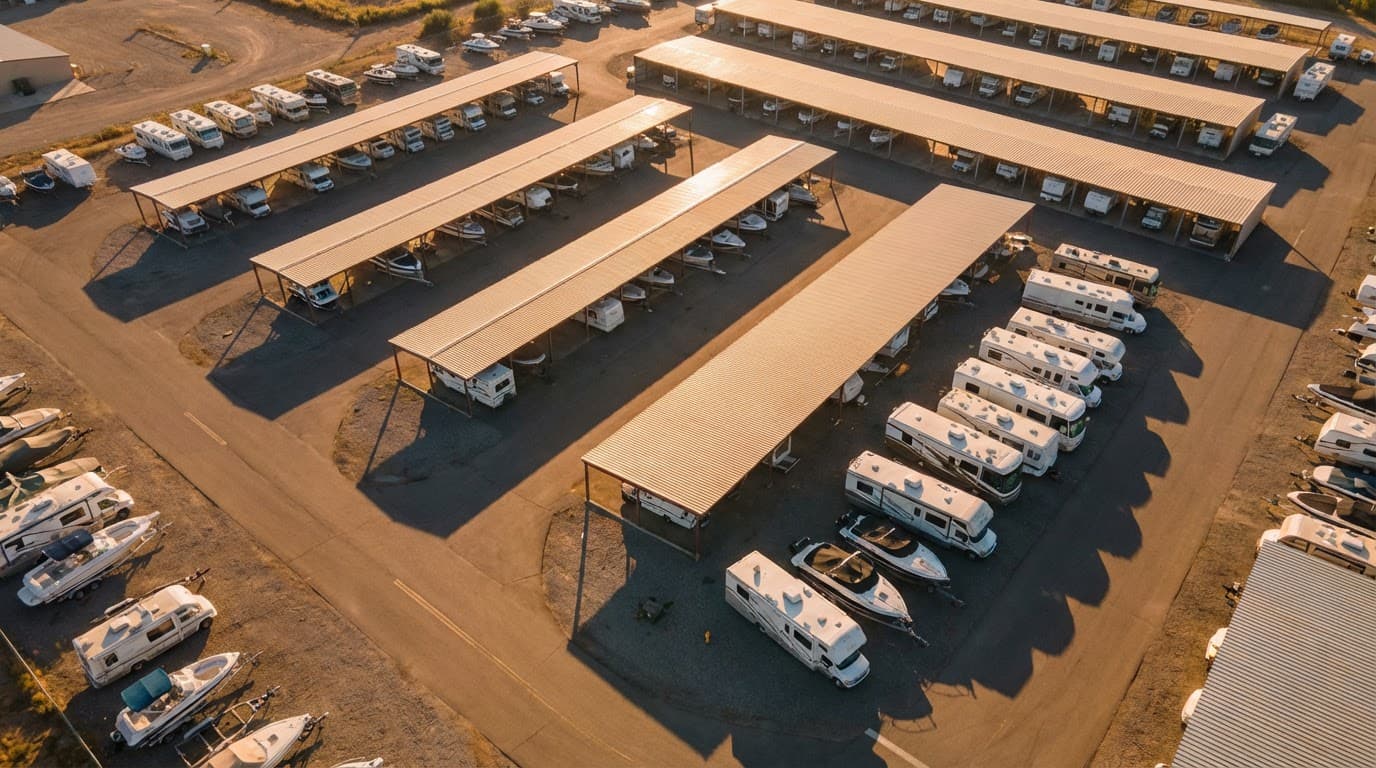
A metal or fabric roof covers your parking space, but the sides remain open to the air. Covered storage eliminates direct sun exposure and most precipitation intrusion. It does not protect against wind-driven rain or significant temperature swings. This middle-tier option is the most popular category in most markets because it delivers meaningful protection at a fraction of the cost of enclosed storage.
Typical monthly cost: $100–$250 depending on space size and location.
Pros of covered storage:
- Eliminates direct UV radiation — the primary cause of roof seal deterioration, canvas fading, and gelcoat oxidation
- Protects against most rain and light snow load
- Significantly lowers long-term maintenance costs compared to outdoor storage
- Better availability than indoor storage
- Usually accommodates standard-size rigs without the height restrictions common in enclosed facilities
Cons of covered storage:
- Open sides allow wind-driven rain, dust, and debris to reach the rig
- Temperature inside follows the outside — not suitable for electronics or temperature-sensitive contents
- Some covered stalls have 12-foot clearance limits that exclude taller Class A coaches with rooftop equipment
Best for: Most trailered boats and RVs — travel trailers, fifth wheels, and Class B or C motorhomes — that need year-round protection without the cost of enclosed storage. This is also the right choice for moderate climates where the primary threats are UV and rain rather than extreme cold.
3. Enclosed Indoor Storage
Your RV is stored inside a building, fully protected from all weather. Enclosed indoor facilities range from large shared warehouse bays with multiple rigs parked side by side, to individual drive-in units with their own roll-up door. Security is generally highest in this category, and access is controlled at the building level rather than just at a perimeter fence.
Typical monthly cost: $150–$500 for most rigs, with large Class A coaches reaching $600 or more per month in high-demand markets.
Pros of enclosed indoor storage:
- Complete protection from UV, rain, hail, snow, and freeze-thaw cycles
- Highest security — building walls, multiple locks, and limited access points
- Roof seals and exterior components last significantly longer than in exposed conditions
- Rodent risk is lower in a secured building than in open or covered lots
- Some insurance companies offer premium reductions for indoor storage
Cons of enclosed indoor storage:
- Highest cost of any standard storage option
- Limited availability — indoor RV storage facilities are common in suburban markets but scarce in rural areas
- Height and width restrictions — standard facilities cap at 12–14 feet and 8.5–10 feet wide; oversized rigs may not fit
- Access may require scheduling at some facilities rather than 24/7 drive-in access
Best for: High-value Class A motorhomes and fifth wheels, rigs stored in climates with significant hail risk (Texas, Kansas, Colorado), any rig stored for 6 or more consecutive months without regular visits, and owners who want to minimize long-term maintenance costs.
4. Climate-Controlled Indoor Storage
A subcategory of enclosed indoor storage, climate-controlled units maintain a consistent temperature — typically between 55°F and 80°F year-round — using HVAC systems. These are the most expensive RV storage option and are most common in markets with extreme heat (Phoenix, Las Vegas) or severe winters (Minneapolis, Denver).
Typical monthly cost: $200–$600+ for most RV sizes.
Who needs climate control for an RV:
- Owners who store significant personal belongings, electronics, or temperature-sensitive items inside the rig during storage
- Owners of high-end motorhomes with sophisticated electronics, hydraulic leveling systems, or wood cabinetry that is sensitive to humidity extremes
- Climates where winter temperatures regularly drop below 0°F — climate control eliminates freeze risk entirely, simplifying winterization requirements
- Climates where summer temperatures exceed 110°F — extreme heat accelerates deterioration of rubber seals, adhesives, and roofing materials
For most RV owners, standard enclosed storage provides sufficient protection. Climate control is worth the premium cost only when the rig contains items that would be damaged by temperature extremes, or when you need complete freeze protection in a very cold climate.
5. Self-Storage Facility with RV Parking
Many standard self-storage companies designate part of their property for oversized vehicle storage. These spaces are often outdoor or covered, and prices are frequently lower than at dedicated RV storage facilities. Security varies considerably — some self-storage facilities are fully gated with excellent camera coverage; others are open lots with minimal oversight.
Typical monthly cost: $50–$175 depending on space type and location.
Self-storage RV parking is a practical option in suburban and rural markets where dedicated RV storage facilities are limited. Evaluate each facility individually on the same criteria — security, access hours, electrical availability, and space dimensions — that you would use for any storage facility.
Key Features to Evaluate at Any RV Storage Facility
Height Clearance — the Most Overlooked Dimension
Height clearance is the single most commonly overlooked specification when shopping for covered or indoor RV storage. Class A motorhomes with roof-mounted air conditioners, solar panels, extended antennas, or satellite dishes frequently reach 12.5–13.5 feet. Many covered stalls and indoor facilities have a 12-foot maximum. Measure your RV at its tallest point — including everything on the roof — before committing to a facility. Ask staff to confirm the clearance at the entrance gate and inside the stall with a tape measure if you are anywhere near the limit.
Length and Width
Standard outdoor and covered spaces typically run 10–12 feet wide and 40–45 feet long. Large Class A coaches with both front and rear slideouts extended can exceed 45 feet in length. Always confirm the usable stall length, not just the listed dimension — some spaces lose effective length due to drainage grates, overhead beam placement, or the proximity of neighboring units. Bring a tape measure when you tour a facility.
Electrical Hookups
If you want to maintain battery charge during storage, run a dehumidifier inside the rig, or keep the refrigerator cold, you will need electrical access at the storage space. Not all facilities offer this. Shore power hookups at RV storage spaces typically provide 30-amp or 50-amp service and usually add $15–$40 per month to the base rate. If keeping batteries maintained over winter is a priority, prioritize facilities that offer this feature.
Dump Station Access
A dump station lets you drain holding tanks before or after a trip without leaving the facility. Without one, you need to plan a separate dump stop, adding time to every departure and return. Many dedicated RV storage facilities include dump station access at no extra charge. Verify whether it is included in the monthly rate or billed separately before assuming it is free.
Security Infrastructure
At minimum, an acceptable RV storage facility should have perimeter fencing, a gated entry controlled by keypad or key card access, and security cameras covering the entire storage area. Ask the facility manager whether there have been any break-ins, thefts, or vandalism incidents in the past 12 months. A trustworthy facility will answer this honestly. You can also browse verified facilities by state in our directory to compare security features across options in your area.
Access Hours
Access policies vary widely. Some facilities offer 24-hour access 365 days a year. Others restrict entry to business hours (8am–5pm weekdays), which is incompatible with early-morning fishing trips or impromptu weekend getaways. Confirm the exact access schedule — not just whether they advertise "extended hours" — before signing a lease.
Wash Bay and Service Area
Some dedicated RV storage facilities provide an on-site wash bay, basic tool access, or a service area where you can perform maintenance tasks. These amenities save significant time and money by allowing you to prep your rig before trips or address minor repairs without hauling it to a separate location.
Preparing Your RV Before Storage Drop-Off
Regardless of which storage type you choose, a few preparation steps protect your rig between uses.
Interior Preparation
- Remove all food — even canned goods that can freeze and rupture, and any trace of food smell will attract rodents. See our complete RV winterization guide for the full preparation checklist
- Leave cabinet and closet doors slightly open to allow air circulation and prevent musty odors
- Place desiccant moisture absorbers throughout — at least two in the main area and one in each bedroom and bathroom
- Clean and dry the refrigerator completely, then leave the door propped open
- Turn off the water heater and water pump
- Drain and winterize all water lines if temperatures at the storage site will drop below freezing
Electrical and Battery
- Disconnect the main battery if no shore power is available — or connect a smart battery maintainer to keep the charge stable
- Turn off all 12V circuits that draw parasitic current when not in use: LP gas detector, stereo, clocks, and any aftermarket accessories
Exterior and Roof
- Inspect and reseal all roof seams and around all roof fixtures — a single season of missed sealant maintenance can allow water intrusion that damages decking
- Condition all rubber seals on slide-outs, windows, and doors
- Inflate tires to the upper end of the manufacturer's recommended range — tires lose 1–2 PSI per month in cold storage
- Apply UV protectant to rubber and vinyl exterior components
- Install tire covers for any outdoor or covered storage situation
RV Storage Type Comparison
| Factor | Outdoor | Covered | Enclosed | Climate Controlled |
|---|---|---|---|---|
| Typical monthly cost | $50–$175 | $100–$250 | $150–$500 | $200–$600+ |
| UV protection | None | Good | Complete | Complete |
| Rain protection | None | Partial | Complete | Complete |
| Temperature control | None | None | None | Yes |
| Security level | Basic | Moderate | High | High |
| Height restrictions | Usually none | Typically 12–14 ft | Varies by facility | Varies by facility |
| Availability | High | Moderate | Limited | Very limited |
| Electrical hookups | Rare | Sometimes | Often available | Usually available |
| Best for | Budget storage, frequent use | Most RVs, year-round | High-value rigs, long storage | Extreme climates, luxury rigs |
Which RV Storage Type is Right for You?
For most RV owners storing a rig valued at $30,000 or more, covered storage is the minimum worth considering. The UV and rain protection significantly extends the life of roof seals, exterior graphics, awning fabric, and roofing material. The additional cost compared to outdoor storage typically pays for itself many times over in reduced maintenance and repair bills.
Enclosed indoor storage is the right choice for high-value Class A motorhomes, any rig stored for 6 or more consecutive months without regular access, and owners in climates with significant hail risk or sub-zero winters. The higher monthly cost is offset by lower long-term maintenance expenses and the peace of mind that comes from knowing the rig is secure in all weather conditions.
Climate control is worth the premium only in extreme climates or for rigs with contents that are sensitive to temperature swings. For the majority of owners in most US climates, standard enclosed storage provides fully adequate protection.
Search RV storage facilities near you to compare options, read verified reviews, and find facilities with the features that matter most for your rig.