
RV Storage Size Guide: What Spot Do You Actually Need?
By FindBoatStorage Research Team · Published March 2026 · Updated March 2026 · Based on verified data from our directory
Getting the Right Storage Space Size for Your RV
Renting a storage spot too small for your RV can result in a damage claim or rejection at the gate. Renting one too large means paying for space you do not need. Based on our database of 10,431 verified facilities across 48 states, getting your size right is the single most common issue new RV storage customers face. Here is how to get it right the first time.
Understanding RV Classes and Their Storage Implications
RVs fall into two broad categories: motorized (Class A, B, and C motorhomes) and towable (travel trailers, fifth wheels, toy haulers, and pop-up campers). Each class has distinct dimensional characteristics that directly affect which storage spaces are appropriate.
Class A Motorhomes
Class A motorhomes are the largest and most luxurious motorized RVs. Built on a commercial bus or truck chassis, they range from 26 to 45 feet in length, with most diesel pushers and luxury coaches clustered at the 38–45 foot end. Height is a critical consideration: Class A coaches typically stand 12 to 13.5 feet tall, and many feature rooftop satellite dishes, additional AC units, or antennas that push clearance requirements even higher.
Slide-outs are extremely common on Class A units. While slides do not affect storage space length, they must be retracted before entering any storage facility. Even retracted, the slide motor housing on the exterior wall may add an inch or two of width — confirm your total retracted width with a tape measure, not a spec sheet.
Class A units require a minimum 40-foot space; most operators recommend 45 feet or more for comfortable entry and exit. Indoor clearance of at least 13.5 feet is required for most units, and 14 feet is preferable for coaches with after-market satellite dishes or roof-mounted accessories.
Class B Motorhomes (Camper Vans)
Class B motorhomes are built on full-size van platforms (Ford Transit, Mercedes Sprinter, RAM ProMaster) and represent the compact end of the motorhome spectrum. Standard Class B vans run 17 to 22 feet in length and 7 to 7.5 feet wide. High-roof variants typically stand 9 to 9.5 feet tall — low enough to fit in most standard parking garages and virtually every storage facility with indoor options.
Class B units are the easiest to store. A 20-foot space accommodates nearly all van conversions, and their modest height means height restrictions are rarely a concern. Many owners can use standard self-storage units with drive-up access.
Class C Motorhomes
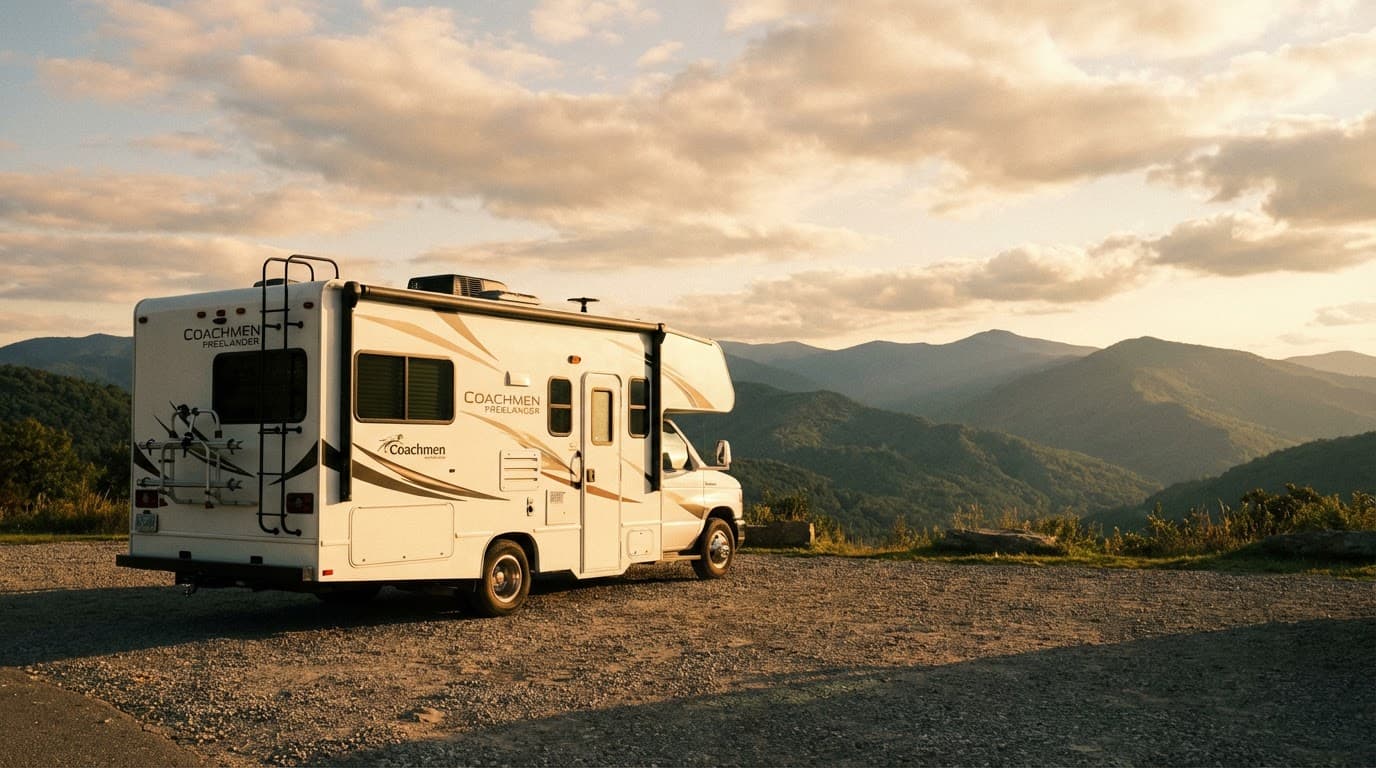
Class C motorhomes are built on a cutaway truck chassis and are identified by the distinctive cab-over sleeping area. They range from 20 to 35 feet in length and 11 to 12 feet in height. The cab-over overhang is a key measurement point — it extends forward past the front bumper and must be included in your total length calculation.
Mid-size Class C units (22–28 feet) are the most commonly stored RV type in our facility network. A 30-foot space works well for most Class C coaches. Larger units approaching 35 feet will require a 40-foot reservation. Height is typically 11 to 12 feet — confirming indoor clearance above 12 feet provides a comfortable margin.
Fifth Wheels
Fifth wheels are towable RVs designed to hitch to a specialized fifth-wheel hitch in the bed of a pickup truck. They range from 25 to 40 feet in body length, with heights of 12 to 14 feet — among the tallest towable RVs. The raised front section (the "pin box" and goose neck area) accounts for much of this height and also creates a distinctive two-level profile.
When measuring storage space requirements for a fifth wheel, measure only the trailer itself — the tow truck is driven away. Account for any rear-mounted accessories. Height is particularly important: a 13.5-foot fifth wheel will not fit in a facility with a 13-foot clearance bar. Always provide your actual measured height, not the manufacturer spec, which may not include aftermarket additions.
Travel Trailers
Travel trailers (also called conventional trailers or "bumper pulls") are the most diverse category in RV storage. They range from compact 14-foot teardrop trailers to full-size 40-foot luxury coaches. Heights vary from about 10 feet for smaller units to 13 feet for larger models. Width is typically 7.5 to 8.5 feet.
Like fifth wheels, travel trailers are stored without the tow vehicle. Small travel trailers under 25 feet can fit in a 25-foot space with room to spare. Large travel trailers approaching 40 feet need a 40 to 45-foot space. The tongue (the forward coupler hitch hardware) extends 18 to 36 inches past the front of the trailer body and must be included in your measurement.
Toy Haulers
Toy haulers are a specialized category of either fifth wheels or travel trailers with a rear garage area for motorcycles, ATVs, or golf carts. They tend to run heavy and are often at the longer end of their respective classes. A toy hauler fifth wheel may be 38 to 42 feet in overall length. Lengths and heights mirror the parent class, but the extra weight load means they often sit lower on their suspension — measure height with a full load if you plan to store with gear inside.
Pop-Up Campers (Folding Camping Trailers)
Pop-up campers are the smallest and most storage-friendly towable RVs. When folded for transport and storage, they typically stand only 4 to 6 feet tall — low enough to fit in standard enclosed storage units or even residential garages. They range from 14 to 22 feet when folded. Their compact footprint means storage cost is minimal, and nearly any facility can accommodate them.
Complete RV Dimensions and Recommended Storage Space Guide
| RV Type | Typical Length | Typical Height | Typical Width | Recommended Min. Space | Min. Indoor Clearance |
|---|---|---|---|---|---|
| Pop-up camper | 14–22 ft | 4–6 ft (folded) | 7–8 ft | 20 ft | 7 ft |
| Class B van | 17–22 ft | 8–9.5 ft | 7–7.5 ft | 20 ft | 10 ft |
| Travel trailer (small) | 18–25 ft | 10–11 ft | 7.5–8 ft | 25 ft | 12 ft |
| Class C motorhome (small) | 20–28 ft | 11–12 ft | 7.5–8.5 ft | 30 ft | 12.5 ft |
| Travel trailer (large) | 25–40 ft | 11–13 ft | 8–8.5 ft | 40 ft | 13.5 ft |
| Fifth wheel | 25–40 ft | 12–14 ft | 8–8.5 ft | 40 ft | 14 ft |
| Class C motorhome (large) | 28–35 ft | 11–12 ft | 8–8.5 ft | 40 ft | 13 ft |
| Toy hauler (travel trailer) | 28–38 ft | 12–13 ft | 8.5 ft | 40 ft | 13.5 ft |
| Class A motorhome (small) | 26–35 ft | 12–13 ft | 8–8.5 ft | 40 ft | 13.5 ft |
| Toy hauler (fifth wheel) | 32–42 ft | 13–14 ft | 8.5 ft | 45 ft | 14.5 ft |
| Class A motorhome (large) | 36–45 ft | 12–13.5 ft | 8.5 ft | 45–50 ft | 14 ft |
How to Measure Your RV Correctly
Manufacturer specifications are a starting point, not the final word. Specs often exclude hitch hardware, rear bumper extensions, generator compartments, bike racks, spare tires, and aftermarket additions. Follow this measurement protocol for accurate storage sizing.
Measuring Length
For motorhomes, measure from the front bumper (or any forward-protruding tow bars or steps) to the rear bumper or any rear-mounted accessory (bike rack, spare tire, cargo carrier). This is your total stored length.
For towable trailers, measure from the tip of the hitch coupler (the very front of the tongue hardware) to the rear bumper or rear-mounted accessory. This is the length of space the trailer occupies in storage. Do not include the tow vehicle.
Add 2 feet to your measured length as a margin when shopping for storage space. A 34-foot Class A should be quoted as needing a 36-foot space minimum — though most operators will recommend a 40-foot space for comfortable access.
Measuring Height
Measure from ground to the highest point on the vehicle. This is usually the main roof air conditioning unit, a rooftop solar panel edge, an antenna, or a satellite dish. Use a tape measure extended vertically from the ground, or have a helper hold the end at the highest point while you read the measurement.
Important: measure with the vehicle on a level, hard surface. Soft ground or gravel can allow tires to sink slightly, altering the effective height. Also measure with tanks at typical travel load — a heavily loaded motorhome sits lower, which paradoxically can help with height clearance on indoor facilities.
For indoor storage, add at least 6 inches to your measured height. A unit that measures exactly 13 feet should be treated as needing 13.5 feet of clearance. Variance in parking surface grade, tire pressure changes in cold weather, and RV accessory additions all reduce your margin.
Measuring Width
Width is less often the limiting factor but still important for facilities with narrow drive aisles or tight indoor bays. Measure at the widest point — typically the outer edges of the slide-out motor housing, tow mirrors on motorhomes, or rear cargo panels. Most outdoor lots accommodate anything under 9 feet without issue. Indoor facilities may have lane widths as narrow as 12 to 13 feet, leaving only 2 feet of clearance per side for an 8.5-foot-wide unit.
Drive-Through vs. Pull-Forward (Pull-In) Storage Spaces
This distinction matters enormously for long vehicles, and it is one of the most overlooked factors when reserving storage.
Drive-Through Spaces
Drive-through spaces allow you to enter from one end and exit from the other, eliminating the need to back out. They are the gold standard for large motorhomes and long fifth wheels. A 45-foot Class A in a drive-through space requires only that you can drive forward — no backing skill required. Most large RV storage facilities that handle Class A coaches offer at least some drive-through spaces, though they command a premium.
Pull-Forward (Pull-In) Spaces
Pull-forward spaces require you to back out when leaving. For a 30-foot travel trailer, backing out of a standard outdoor space is manageable with practice. For a 42-foot diesel pusher on a tight gravel lot, backing out can be a genuine challenge and a risk for neighboring vehicles. If you have a large Class A or a long fifth wheel and your facility only offers pull-in spaces, factor in your backing confidence and the aisle width before signing a lease.
Pro tip: ask the facility for photos or a site visit before committing. Many facilities have aerial photos available that clearly show space layout and aisle widths.
Height Restrictions at Indoor Storage Facilities
Indoor RV storage is the premium option and is covered in detail in our RV storage options guide. Height clearance is the most common reason an indoor space reservation falls through. Here is what you need to know.
Indoor facilities designed specifically for RVs typically advertise clearances of 12, 13, 14, or 16 feet. A 12-foot clearance accommodates most Class B vans, small Class C units, and small travel trailers. A 14-foot clearance handles the vast majority of Class A motorhomes and fifth wheels. Facilities advertising 16-foot clearance are relatively rare but can accommodate nearly any production RV on the market.
Critical details to confirm before signing:
- Is the advertised clearance the door height or the interior clearance? (Door height and interior clearance can differ if there are overhead pipes or structural elements inside.)
- Is the clearance uniform throughout the bay, or does it vary at certain spots?
- What is the clearance at the front of the space versus the back? (Some older warehouse conversions have lower clearance at the interior end.)
- Does the facility have a height bar at the entrance that physically blocks oversized vehicles? (Most reputable facilities do — if yours cannot clear the bar, do not attempt to force it.)
What Happens If You Underestimate Your RV's Size
Underestimating storage size creates three categories of problems: physical damage, administrative rejection, and safety incidents.
Physical damage is the most costly. An RV that is 2 inches taller than the indoor clearance bar will sustain significant damage if the driver does not stop in time. Rooftop AC units, antennas, and solar panels are vulnerable. Damage claims in this scenario are typically the owner's liability — not the facility's — since the owner certified the vehicle fit the space.
Administrative rejection happens when a facility attendant measures your vehicle at check-in and determines it exceeds the reserved space dimensions. You will be turned away, often after driving a long distance. Many facilities charge a cancellation or rebooking fee in this scenario.
Access difficulties arise when a unit technically fits in a space but has insufficient clearance on the sides. Squeezing a wide fifth wheel into a space with only 6 inches of clearance per side means every entry and exit is a high-stress maneuver and eventual contact is likely.
The solution is simple: always measure your actual RV with a tape measure, add appropriate margins, and verify with the facility before committing. When in doubt, book the next size up. The price difference between a 40-foot and 45-foot outdoor space is typically $10–$20 per month — far less than a deductible for door damage.
Urban vs. Rural Facility Size Availability
Not all facilities offer the full range of space sizes, and availability varies significantly by geography. Based on our data across 10,431 facilities in 48 states, urban facilities in high-density areas (major metro cores, coastal cities) tend to have smaller average space sizes, shorter maximum lengths, and less availability of 45+ foot spaces. Land is expensive, and facilities optimize for smaller, higher-turnover units.
Rural and suburban facilities — particularly those built on large parcels in Sun Belt states like Texas, Arizona, and Florida — are more likely to offer 50-foot outdoor spaces, drive-through lanes, and dedicated large-vehicle rows. If you own a Class A diesel pusher and live in a dense urban area, you may need to search a wider radius or budget for a longer drive to your storage location.
Our facility search tool allows you to filter by state and city and browse verified facilities in your area. Contact facilities directly to confirm maximum vehicle length before making the trip.
Common Mistakes When Reserving Storage Size
- Using manufacturer specs instead of measuring. Manufacturer length specs almost never include the hitch coupler on towables or rear-mounted accessories on motorhomes. Always measure the actual vehicle.
- Forgetting the tongue on travel trailers. The tongue adds 18–36 inches to the front of the trailer. A 30-foot trailer body with a 30-inch tongue needs a 32.5-foot space minimum.
- Ignoring height for outdoor storage. Height matters for outdoor covered spaces too — many covered facilities have canopy beams at 12 to 13 feet. Check even if you are not going fully indoor.
- Not accounting for slide-out width. Slides are retracted in storage, but the exterior housing can add to the vehicle's width profile. Confirm retracted width with the manufacturer if you have any doubt.
- Assuming all spaces within a facility are the same size. Many facilities have mixed inventory — a "40 ft space" row and a "30 ft space" row and a premium "50 ft drive-through" section. Confirm the specific space type you are reserving.
- Not asking about aisle width. A 45-foot Class A technically fits in a 50-foot drive-through space, but if the aisle is only 18 feet wide, making the turn to enter the space may be impossible for a 45-foot bus-chassis coach.
- Booking before visiting. For large, expensive RVs, a site visit before signing is worth the trip. Walk the space, check the surface (asphalt, gravel, concrete), and evaluate the entry angles yourself.
Tips for Oversized Vehicles
If your RV exceeds 45 feet in length or 13.5 feet in height, your options narrow but do not disappear. Here is what experienced Class A owners recommend:
- Search for facilities that explicitly advertise "oversized" or "bus storage" in their listings. These are often former commercial vehicle yards or specially built RV parks with expanded infrastructure.
- Contact facilities by phone rather than relying on online booking forms, which may not accommodate custom dimensions.
- Ask about ground surface. Soft ground settles under the weight of a 30,000-pound diesel pusher. Concrete or packed asphalt is preferable for long-term storage.
- Look for facilities with 24-hour access if you tour frequently — many oversized bus owners need early morning departure access before staff arrive.
- Budget for a longer drive: the nearest appropriate facility for a 45-foot Class A may be 30–50 miles from your home in some metro areas.
Finding the Right Facility for Your RV Size
Browse our verified storage directory to find facilities near you. Each listing includes information provided directly by the facility operator on available space sizes and height clearances. When contacting a facility, bring your measured length and height ready — a facility that takes those numbers seriously and confirms your unit fits before you arrive is worth the extra phone call. Getting the right size the first time saves money, prevents damage, and starts your storage relationship on the right foot.
Related Tools
📐Storage Size Guide →
Find the right spot size for your specific vehicle — with storage type recommendations.